When the ATLAS telescope in Chile picked up a faint moving point of light on 1 July 2025, astronomers didn’t expect history to repeat itself. Yet the object, later named C/2025 N1 (ATLAS) — or simply 3I / ATLAS — turned out to be interstellar, coming from far beyond our Solar System. It’s only the third known interstellar object, after 1I / ʻOumuamua in 2017 and 2I / Borisov in 2019. Each has given us rare insight into what other star systems are made of — and 3I / ATLAS is already proving just as fascinating.
Discovery and Confirmation
ATLAS ( Asteroid Terrestrial-impact Last Alert System ) routinely scans the sky for objects that might come close to Earth. On July 1, astronomers noticed a dim speck drifting between the stars. Within days, further observations from Chile, Hawaii, and the Canary Islands confirmed something remarkable — the orbit was hyperbolic, meaning it wasn’t bound to the Sun.
Calculations from NASA JPL’s Small-Body Database showed that the object was moving too fast — around 58 km per second — to have formed inside the Solar System. The International Astronomical Union officially designated it 3I / ATLAS, with “3I” marking it as the third interstellar object ever found.
▲ A comet trail seen through the AI’s visual mapping lens.
Image generated using Gemini AI
What Makes 3I / ATLAS Unique
-
Comet-like Activity
Unlike ʻOumuamua, which looked rocky and had no visible tail, 3I / ATLAS behaves more like a comet. Early images from Gemini Observatory and Rubin Observatory showed a compact coma — a fuzzy cloud of gas and dust — and a growing tail. That indicates the surface is ice-rich and vaporizes as it warms, releasing material from another star’s planetary nursery.
-
Rapid Brightening and Color Changes
As it approached the Sun, 3I / ATLAS brightened unusually fast. Observers even reported a faint bluish-green hue, hinting that gases such as carbon monoxide, carbon dioxide, or cyanogen (CN) dominate the emissions.
Spectroscopic studies under review on arXiv suggest the comet may have an exotic chemistry, possibly richer in CO gas than typical Solar-System comets. -
Uncertain Size but Enormous Interest
Some early media headlines suggested a huge nucleus several kilometers wide. However, researchers note that the coma’s brightness can easily exaggerate size estimates.
Current best fits indicate a moderate nucleus — perhaps hundreds of meters across — though ongoing analysis of Webb and Hubble data will refine that.
Why Scientists Care So Much
Every interstellar object is a sample of another solar system. Its ices and dust grains were shaped by a different star, different radiation, and possibly different planet-forming chemistry.
By studying these visitors, scientists can compare:
- Elemental ratios (like carbon : oxygen) across star systems.
- How dust and organic molecules form in alien environments.
- Whether certain volatiles are universal in planetary building blocks.
NASA, ESA, and observatories worldwide quickly launched a coordinated observing campaign —
optical, infrared, and even radio telescopes working together.
Because 3I / ATLAS passed near the orbital plane of Mars, some spacecraft instruments (Mars
orbiters and other planetary probes) had vantage points impossible from Earth, helping capture
unique phase-angle data.
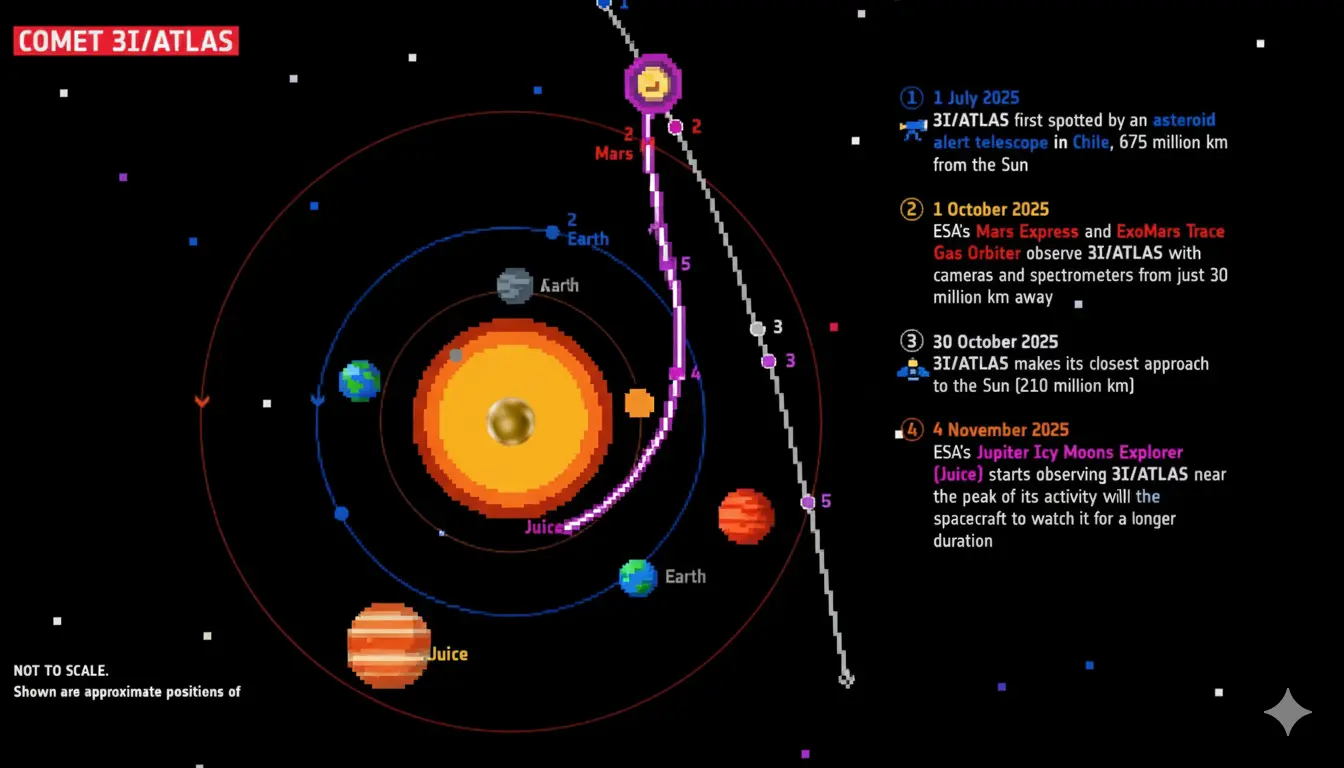
▲ A stylized visual timeline of 3I / ATLAS’s journey through the Solar System.
Image generated using Gemini AI
A Timeline of Key Events
| Date (2025) | Event |
|---|---|
| June (pre-discovery) | Archival images later revealed 3I / ATLAS a week before official detection. |
| July 1 | ATLAS discovers the object; preliminary orbit shows hyperbolic trajectory. |
| July 3–10 | Follow-up observations from Gemini, Rubin, and amateur astronomers confirm interstellar origin. |
| August–September | Increasing brightness; first spectroscopic detections of gas emission lines. |
| Late October | Perihelion passage — comet reaches maximum brightness with visible greenish coma. |
| November onward | Data analysis phase; orbital modeling refined and scientific papers submitted. |
Misinformation: What to Be Skeptical Of
As with previous interstellar discoveries, sensational claims followed almost instantly.
- “Alien Signal” Stories
Viral posts alleged repeating radio pulses or Fibonacci-pattern signals.
✅ Fact: No verified observatory (NASA, ESA, or SETI) has reported any non-natural emission from 3I / ATLAS. The supposed “signals” were artifacts of terrestrial interference. - “Planet-Killer Comet” Headlines
Because of its size uncertainty, a few outlets speculated about impact risk.
✅ Fact: Its hyperbolic orbit means it’s leaving the Solar System after perihelion — there is no collision threat to Earth.
Conclusion
3I / ATLAS reminds us that space is far from empty — it’s a cosmic crossroads where materials
from different stars occasionally pass by our Sun.
Just as ʻOumuamua rewrote what we thought interstellar rocks could look like, this new visitor
is expanding our understanding of comet chemistry and planetary origins.
While social media fuels myths and hype, the real story — hidden in telescope spectra and
orbital math — is even more awe-inspiring: we are witnessing a piece of another world drift
through our cosmic backyard.
Learn more about current tracking of interstellar visitors on NASA’s official site and ESA’s Science Portal.
Leave a Comment
Comments